
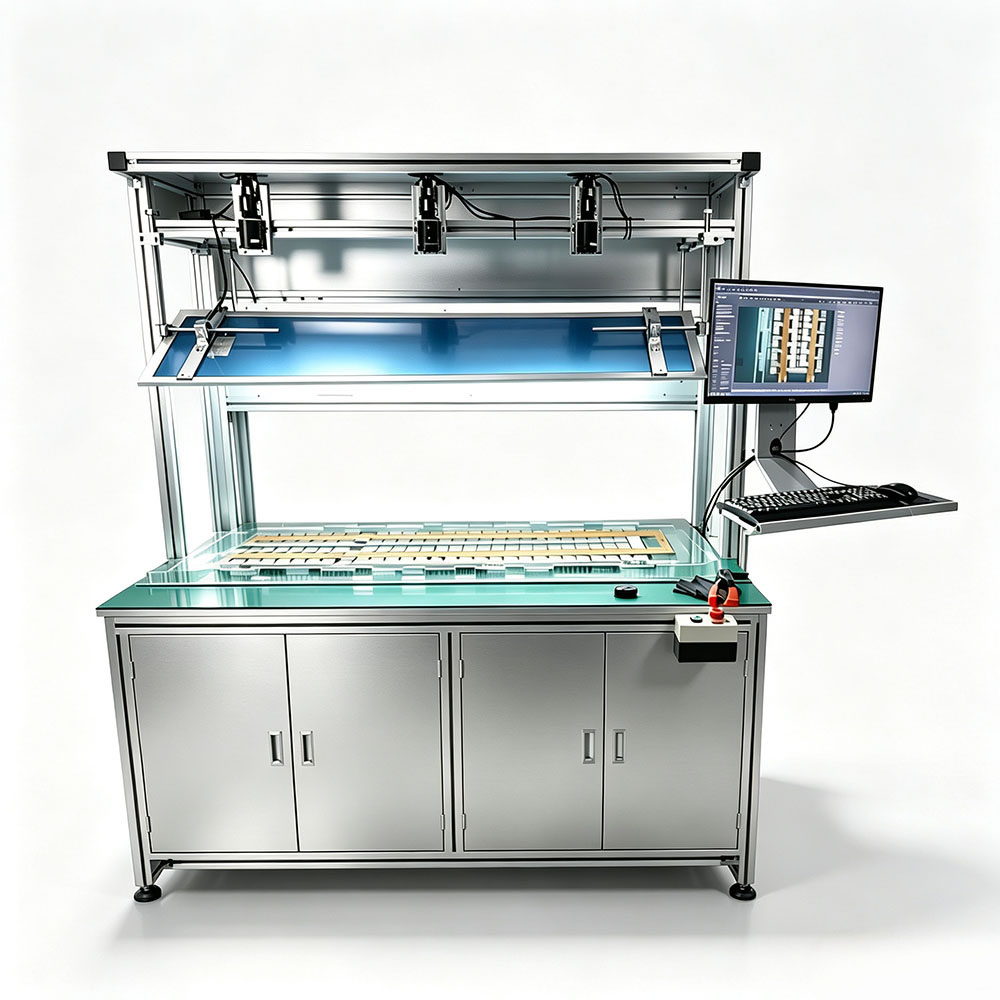
This equipment is custom-built for CCS integrated busbar mass production lines, focusing on the final full-item quality inspection process before packaging and warehousing. Equipped with a high-precision industrial machine vision inspection system, it replaces traditional manual visual inspection to achieve automated high-speed final inspection of CCS busbar appearance defects, dimensional deviations, accessory completeness, marking printing, assembly positioning, and other items. Visual repeat inspection accuracy can reach 0.02mm, with a missed detection rate of <0.01%. Inspection judgment standards are unified and standardized, thoroughly eliminating manual subjective judgment errors. Inspection data is stored in real time, and defective products are automatically intercepted and diverted, fundamentally preventing defective products from entering warehousing and shipping stages, greatly reducing customer complaints and rework costs. It adapts to the rigid quality control needs of large-scale mass production of new energy power battery CCS.
Solving Customer Pain Points
Poor stability of manual inspection: Small defects in CCS busbar solder joints, plastic parts, insulation layers, and buckles are extremely prone to missed detection and misjudgment by the naked eye. Long-term eye fatigue leads to persistently high missed detection rates, posing high risks of customer returns and claims after batch shipment.
Final inspection efficiency cannot keep up with production line takt time: New energy battery production lines have fast automated takt times. The labor cost of multi-person assembly line visual inspection rises year by year, and the manual inspection speed bottleneck restricts the capacity release of the entire production line.
Inspection data cannot be standardized and traced: Manual inspection lacks unified judgment standards, and inspection results cannot be digitally archived. When quality problems occur, it is impossible to trace back the inspection responsible person and inspection time, failing to meet the IATF16949 quality system audit requirements of automakers and major power battery manufacturers.
Defects discovered only after packaging, resulting in extremely high losses: Defective products are only detected after complete packaging, and unpacking, rework, and repackaging cause multiple wastes of materials, packaging consumables, and labor hours.