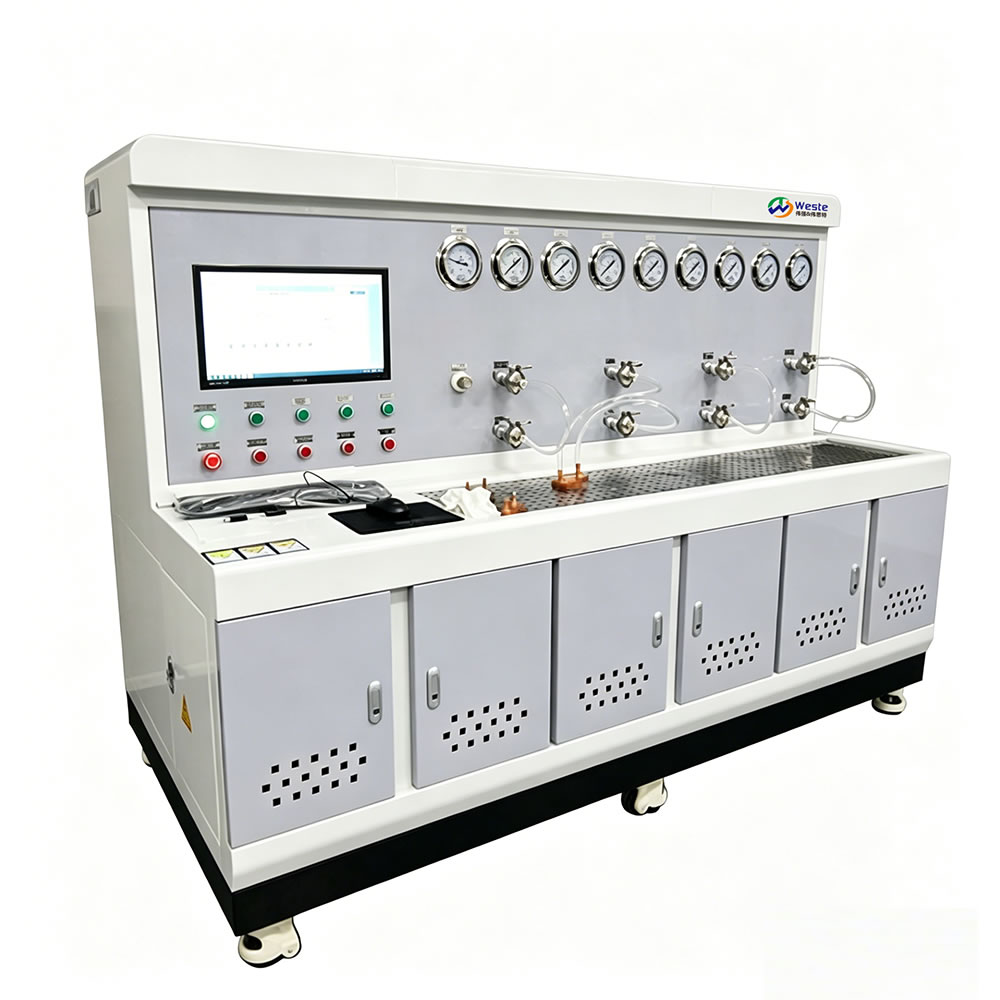
The Liquid Cooling Plate Flow Resistance and Thermal Resistance Performance Testing System is a comprehensive testing platform specifically designed for heat dissipation components such as data center liquid cooling plates, used to evaluate two core indicators: flow resistance characteristics and heat dissipation efficiency.
Flow resistance testing precisely controls coolant flow rate (common range 0.2–10 L/min), uses inlet/outlet pressure sensors or differential pressure sensors to measure pressure drop, evaluates the smoothness of the cold plate's internal flow channel design, and plots pressure drop-flow rate characteristic curves.
Thermal resistance testing applies set power consumption by simulating a heating element (such as a programmable power supply heater), combines multi-point monitoring of inlet/outlet liquid temperature and heating element surface temperature, calculates thermal resistance value, and verifies cold plate heat dissipation capability. Testing automatically outputs performance reports and interfaces with MES for data integration.
Main Functional Parameters:
-
Number of Equipment Channels: Dual-channel
-
Number of Heat Sources (Single Channel): Six heat sources
-
Heat Source Power Supply
-
Channel 1: Power: 6000W, Voltage: 0–100V adjustable, Current: 0–60A adjustable, 2 units; Power: 1500W, Voltage: 0–80V adjustable, Current: 0–50A adjustable, 4 units
-
Channel 2: Power: 3000W, Voltage: 0–100V adjustable, Current: 0–60A adjustable, 2 units; Power: 1500W, Voltage: 0–80V adjustable, Current: 0–50A adjustable, 4 units
-
Number of Temperature Measurement Points (Single Channel): 16
-
Equipment Features Segmented Testing Function
-
Data Saving and Uploading Function
Flow Resistance Testing Conditions:
-
Medium: Pure water or antifreeze (with built-in flushing and fluid replacement function; two water tanks: working fluid + flushing fluid)
-
Medium Temperature Range: 5–60°C
-
Flow Rate Range: 0.2–10 L/min
-
Pressure Difference Range: 0–400 kPa
-
Data Saving and Uploading Function